participants

Presenters

Invited Artists

Stephen Robison

Addiction to Ash and Flash
(download the msword file)

Introduction

I have attended several wood fire conferences and have been attending NCECA since 1984, but this has been such an excellent conference I have to say the best ever. The lectures and panel discussions and the questions poised by the audience have all added insight into the use of wood firing. I was entranced by the disconnected and connected thoughts of my friend Kirk Mangus and fell in love with his wife once again when she used the analogy of the apple and the sunlight. In my mind I was traversing the strings of my guitar while some elegant poetry came from the mouth of Ben Richardson. His words were like “Leaves of Grass” for the clay coinsures. When Water Wu from Taiwan discussed the primal value of manual labor and the desire to return to it I again had several chords struck. The discussion on esthetics was filled with great thoughts. The critical discourse in Ted Adler’s presentation was very much and is very much needed. As someone in the audience said it gave many of us something to chew on.  And again Thanks you Jason and the whole crew from the participants to the presenters.

One common thread that has ran through this entire conference and was touch on by almost every presenter is that we are all connected to this endeavor and are passionate about it. Linda Lid on the great panel yesterday morning had so many great answers and suggestions and not just for women but for all of us as individuals. When she talked about the exchange of information I think we need to keep that exchange going and archived. The Log Book and what gets published out of this conference will certainly add to the future of the growth and evolution of wood firing practice but it will also add more insight into the discipline of ceramics in general.
To keeps this ball in momentum I have one major request that I just thought of this morning and that is to stay together through imagery and word as much as possible. I know many of us have taken some excellent shots of the firings, people, the work in the show and the images that each presenter put together for their talks. Now I know this will be easier for the digital savvy but if at all possible the ludites other images would be an excellent edition also. So you old slide people, I hope you can find someone to scan them. If not send them to me and I will scan them and send them back.

A great place to archive this conference would be Flickr. It’s great because it is free and accessible to anyone. Especially the shots of kilns so if anyone were still intimidated by building a kiln there would be more visual info for them to shake their inhibitions. If everyone who has images obtains a free flickr account and uploads all the images they have and tags them as NAU wood fire, then we can see quite a bit of what really happened here. And most important to this suggestion to have some of the images accessible to the rest of the world so they also know and the images can certainly aid in the pedagogy of our discipline.

Addiction to Ash and Flash

When I was first thinking about this talk it seemed pretty easy to talk about some issues that revolve around the clothing, patina or surface we chose for our pieces and our addiction to this fashion called wood fire. Some may resent the world fashion but as something gets to be so popular to practitioners of whatever media it does become a bandwagon that many jump on and jump off when the heat gets to intense or it fades from popularity.

The main problem of being at the end of this particular conference is I feel that the talk I had prepared is somewhat of a reiteration. I had to change it some but for the most part I think reiteration is healthy to many points I will try and make here.

When Nietzsche said, “For art to exist, for any sort of aesthetic activity to exist, a certain physiological precondition is indispensable: intoxication”, you would think he was talking directly to artists who wood fire. Not because many of us like to have a little snort of a good single malt or maybe roll a little tea, but because of the intoxicating qualities of the process. Wood firings are the most intoxicating of any firing technique. Or any process in art period!!!!
This can be a lead into why some of us choose to fire with wood or even why someone would choose ceramics as their media. Why does this process intoxicate us and what are the other reasons we choose to fire with wood? Every question I bring up in this talk of course would be answered differently by each of us and I dare to say some have yet to ask why they wood fire. Maybe their answer is, “Why not? I like it.” That’s a fine answer. I have always loved the naked clay and it always died when it dried. We all know how the kiln brings it back to life and some chose to have it have be scantily clad and some chose to covered up with a big bulky sweater of a thick crawling shino or heavy ash deposits.
I want to try to encapsulate a general consensus on what many people feel about this endeavor and why they choose to fire this way. Some of the things that came to mind when I started thinking about this are definite answers, which I have seen in over a decade of working with the process. These answers are not all reflective of my personal use of the technique, but I know many in this audience can relate to at least one of them. 

So why do people fire with wood?  In an historical perspective one has to see that the answer is pretty clear, it was the only fuel available. Contemporary agendas are a bit more complicated than simply out of necessity. In the contemporary use of the process, there are a few other reasons: the machismo factor that I have seen all too often in both men and women, the romantic qualities that may be enticing to some people and those qualities may tie into the antiquity or the old way of doing things, the attachment or assimilation to another culture that we see with the abundance of wood fired work that reflects an Asian esthetic for instance, and possibly the best reason which is the choice to wood fire for whatever esthetic quality one is asking of the process. One other question that may also be an answer to why one would choose this technique: is there content in the final piece that reflects the choice of wood firing? I would have to say yes, there almost always will be some content derived from the firing and the media with which the object was made and what the object is. During the firing, when the elements of the wood or atmosphere of the kiln touch the work, we will have a direct reflection of the time and work ethic involved in the firing. It will sometimes contain the history of the process and present the history of the fire. As much as there is a visual quality when someone chooses to throw a part of a piece or hand build it, the choice of firing can be a content laden esthetic choice or merely a devise to decorate the work. Of course, you can also throw and have no remnants of the process show and you could hand build as though it were made from leather or steel. The same can be said for the choice to wood fire where the process may not be apparent in the final piece. But there is usually a visual voice in the work that comes from whatever media or technique one chooses, even if its not apparent how a piece was made or fired, the voice is still there to the practitioners and coinsures of the technique or media.

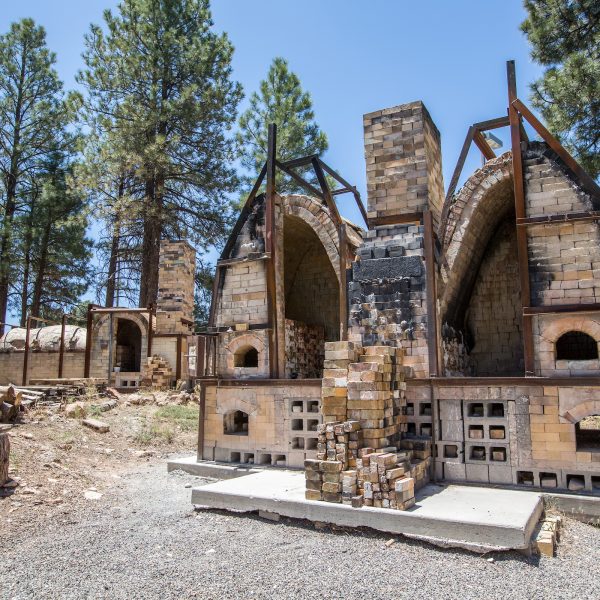
And just like the many different ways you could throw that part or hand build that part there are also many different ways you can fire one particular kiln much less the variety of kilns that are out there that use wood as their fuel. NAU is a prime example of that diversity of kilns.

So what then is the esthetic of wood firing? What are we really talking about when we say wood fired? But is there really one esthetic or is there a plethora of esthetics? I want to go back to a great comment that Louise Cort made in 1999 at the second Wood Fire Conference in Iowa. She observed that everyone was pretty much talking about atmospheric effects from the wood kiln. It seems as though in this conference several years later it is still the focus. Gwen Hansen Pigott is a good example of not fitting in that esthetic framework.  Sometimes we may use wood to obtain nothing more than its release of BTU. Yes, some people who fire with wood don’t want any ash touching their work or any marks from the fire. Of course, historical work is a great example of what I am talking about here. The use of wood as the main fuel before dung, fibrous materials, coal, electricity, oil and gas may have started with some very natural surfaces but later on, refinement of the process became more and more prominent in the objects being produced.

These first two pieces from a southern province of China at the porcelain capital of Jingdezhen are prime examples of wood fired work that has no obvious marks of the process.

This piece from North China, an example of the Song period is a great example of an iron saturate glaze and again has no obvious evidence of the firing process.

This Oribe piece from Japan may have some subtle notes from the fire but still has no direct voice.

This piece of Arita ware has a multiple firing approach.

These two Korean celadon pieces are again great examples of historical work using wood as fuel.

Here are two more excellent Korean pieces.

This piece from Thailand again shows no wood ash or flashing.

Here is another great piece from Thailand.

Here is a piece from Vietnam in this vein.

This is another great Vietnamese wood fired piece and shows the lip as an unglazed surface possibly fired lip to lip so as to not allow any ash to affect the cobalt work in the interior.

And again most of the historic work before the invention of high-fired work was also fired with wood. These Peruvian pieces are great examples.

As far as being addicted to the results of ash and flash and using wood as a way to glaze the work, this image of old water jars from China says it all to me. This is what its about to me. This is why I fire. These are the results I love. Its not about BTU, its about all you can get out of the wood. But again that’s not what its about to everyone and the work itself should not only be about the esthetic.  The addiction of the process unrelated to esthetics will filter into this lecture a few more times.

First of all, to cover the addiction to the process, we need to think about the tools and techniques we use. What are the tools and techniques? The kilns used for wood firing are updraft, downdraft and cross draft designs. We also have several different choices of firebox designs: from internal to external and some that are underneath like Olsen’s fast fire; some that use hobs, grates or mouse holes to lift the wood up so air may get under it; to Emile Bourry’s drawings where the primary air comes in from the top.

Of course we have names for many types of kilns:  pit kilns, bottle kilns and muffle kilns (which are generally updrafts) and beehive kilns that are usually fired as updrafts in the candling of the kiln and then as down drafts once a good draft is established.

This sketch of some bottle kilns are from a shot I saw from Stoke on Trent.

Another group of kilns are the noborigama, sprung arch and catenary arch, which are generally downdrafts with some cross draft action.

This drawing is a nobrigama with caternary arches.  I did this drawing after a Will Ruggles and Douglas Rankin design at Penland. That beautiful kiln has a small exterior fire box made from tatamis .

This drawing is a nobrigama with caternary arches and a large dogi chamber that gives great anagama possibilities.

This Noborigama drawing is reflecting a kiln that Doug Casbeer and Jane Dillan built at the Appalachian Center for Crafts. I lived there for three years and had a great time firing this kiln. It has a Bourry box and the arches are sprung. The bourry box keeps the first chamber pretty free of ash but the flame patterns still are very apparent.

Other kilns are the anagama, cave kiln, tube, train kiln and groundhog kilns, which are all cross drafts.

This is a drawing of a train kiln, which is a fairly new American kiln design developed by John Neeley. This kiln has been built all over the country, as it is fairly easy to build. It has a machined like esthetic to its design and looking like a train in some ways. Many say it is an ugly kiln and it is. But to me ugly is beautiful. I think Bukowski’s face for instance was beautiful. However, I would like to see a sexy train kiln.
 Some are BMW and some are Chevy. I liked the quick Chevy with a small block 350 that Liz showed in the Train Gang panel.  Some have a nice cast lid, some have shelves and soft bricks or fiber blanket.

This last drawing is my favorite kiln and is based on the second kiln I was involved with building. It was a beautiful anagama at The University of Iowa. We had so much fun the first time building it that we blew it up and built it again.  This is the second kiln. That was right before the first Wood Fire Conference at Iowa.  I’m sure some of you remember that.

This is a shot of the side of that kiln in the process of being built that second time. Notice the larger hole through the interior forms!

Here is the other side. This kiln started out as a sketch on a napkin at the Fox Head Bar. Chuck is fond of drawing and I think kicking someone’s butt in pool and throwing a few beers back always sparked his genius. Many of you probably fired this kiln before he got more inspired and built several other great kilns that were a focus at the second conference at Iowa.

The choice of kiln is an esthetic and important choice to think about before building your first kiln. The direction of the flame and what the flame carries with it certainly attributes to a difference in esthetics not only with each type of kiln but also how one chooses to fire it. When loading any of these kilns, the load can change the esthetic of each individual piece too. Where it’s placed in the direction of the flame and all that the flame deposits on the surface is a decision, or it at least it can be. The load can also be filled with saggars in which each piece inside the saggar will be somewhat protected from most of the minerals released from the wood and its bark. The quality or make up of each individual type of tree and even where it grew will also lend some nuances to the makeup of the ash glaze achieved and the speed at which it will release its BTU. Furthermore, some kilns can be fired with little or no ash effects but this is not very likely in the use of a cross draft such as an anagama. Then the individual may choose a kiln with an external firebox such as a Bourry box. However, if the he or she is using the wood solely as fuel in an anagama they may choose to saggar their work. Other esthetic choices are connected to the atmosphere that the kiln is fired in and what temperature you bring it up to and how long you hold it both going up in temperature and down. Some may fire at cone 8 or even lower and some may fire to cone 14 or even higher.  The ash deposits, the color of the clay body, the choice of glazes and even the texture of the glazes can all be polar opposites depending on whether or not one chooses to do a down firing in reduction, or introduces sodium in the form of salt or soda ash, or introduces water as a reduction agent, or fires in a neutral or an oxidizing atmosphere. What I am getting at is that if we are to talk about the esthetic of wood firing, or in this case the addiction or conviction to that esthetic, we cannot generalize.

To be specific, when I am talking about the actual esthetic addiction, I am referring to wood kilns and firing principles that use the wood firing atmosphere with heavy fly ash or light ash, subtle reflections of the flame pattern, dark iron reducing down firing, light traces of salt, salty orange peel or crusty build up of fire box or hibuse effects as ways to embellish the surface or even create the surface of the piece. There are a lot of great firings: some have those pink fleshy porcelains, some produce all the subtleties of brown, red, grey and black tones out of the clays that are chosen, some have heavy slow cooled ash build up that has acquired crystal growth and a structure of interlacing runs that came from a mixture of oak and pine, some have an ashy surprise showing us a mineral that burnt out of some willow that gave you a lustrous gold, and some firings have great glazed surfaces like a shino that has the rich varieties we come to expect from it or magnesium silicate crystal growth on an iron saturate glaze like tenmoku. If we achieve a great firing where there is none of that nasty frog skin that chips off the piece and it was not an over oxidized paste white firing or one of those over reduced drab brown carbon cored firings, can we see the individual pieces for what they are?  Once you achieve the skill of firing, can you really be as critical as you need to be about an individual piece as a whole? Does the skill of a technique and a critical eye go hand in hand? In the world of wood firing, to some degree, I believe it does. I think that to delve into such a time consuming process the serious clay person will be more and more critical.

When I started firing there were no books on wood firing and not really any discourse around the subject. There were a few great articles in Studio Potter and Rhodes wrote a bit about it in his kiln book. Now there is the internet and from the last presentation we see once again another book is out. Thanks so much for your hard work Mark.

When Mr. Wu brought up that primal urge in his presentation yesterday I couldn’t of course think of FIRE. Fire is the most internalized experience; it is innate in all humans and again goes back to how we are connected. The primal urge to split wood and be in such an intimate relationship with fire is probably what created my addiction to wood firing may have helped me continue to stay turned on and try develop as an artist and potter, in turn, learning to fire with wood has led me to have a more critical understanding of what I want to achieve. The vast of array of techniques within wood firing and the diversity of the kilns that can be used is addicting.

But it is the idea of the work that is the most important and getting caught up in technique is always a dangerous addiction that may make us not question the success of those ideas. Sometimes this addiction may require rehabilitation. If an individual is going through the motions and firing with wood with no real thought about why and what it is doing for their work, then they may be on a slippery slope to a serious period of stasis.  If you are at that point you may want to revert to some nice quiet electric firing where no real thought during the firing or loading is needed.

Deciding when to turn the switch on or whether to common post or not are the two major choices to be made. Don’t get me wrong here though, all glazing and firing techniques are equally as valid when esthetics and concepts are concerned.  And every technique can blind the artist caught up in it. The success of the technique does not validate the work. If an individual, lets say, can glaze with majolica as well as Linda Arbuckle can, but he or she makes forms that may not be fitting with the surface or the forms are about utility and the handle is just not taking into consideration any concepts of balance or ergonomic principles, then the work is mediocre at best. So what makes the work average and how do we have our work evolve? The equation is much more complicated than learning how to fire, fabricate, throw, or cast your work.  Its that old adage, if you can’t make it good, make it big or paint it red or in the case of ceramics, fire or glaze it well. We have a similar saying in ceramics, “Putting a tuxedo on a turd”. I am not sure where that came from, but I do know we all have had some sort of learning curve and have all dressed up many a terrible piece. I dare to say, if you are not still learning, you may be falling below the curve. I wonder if this addiction to process and the outcome of the process makes us complacent. Or to use Nietzsche again, as he spoke about religion being the opiate of the masses, maybe wood firing is the opiate of ceramicists.

I remember in the Hamada video by Susan Peterson that Hamada did a drawing of every piece that came out of his kiln. I really doubt he actually did, but the idea is sound.  He was doing this at a stage in his career where most Americans and Europeans would not critically assess their work. I believe he did this as an assessment tool. I believe he was doing this as a way to learn what was really working with each piece and what needed work. I had some great teachers who all told me how important it was to document your work. Chuck Hindes coaxed me to draw the load of a kiln and keep track of how the kiln was loaded as a record that I could reference back to when I looked at the individual pieces. Reflection as a tool for growth is sometimes biased and sometimes analyzing your own work without the passing of time is difficult and when you are caught up in the turbulence of the fire it is also difficult. Getting it out of the environment of the other pieces around the kiln also helped me to look at each piece. I’ve been documenting my work since 1984. I throw away fewer slides now than I did ten years ago, partially because the quality of the slides has improved but mostly I like to think it’s the quality of the work. Documentation is so much easier now with digital media and when we see our work within the context of a nice gradient background we have no distractions to fool our eyes. That is an arena where you can see the piece a little clearer and discern its successes and failures.  Although I agree with a colleague of mine that quite often it isn’t about the work as much as the photography of the work. It’s a jab but it’s a comment that really holds some water, especially since you really don’t know a painting or a pot until you actually experience it. When Mrs. Hatcher was showing her work I was enjoying it until it came to her large platters that were in the show, but when I saw the pieces and experienced them in their command space and saw subtleties and depth of her glaze work I wanted to buy one. One other way to use photography other than as a way to document your work or as marketing tool is to use it as a tool for analysis. I thought, if I was being blinded by technique, then what if I took the image of the piece into Photoshop and removed the surface, could I then see the balance of the form or the ideology I’m trying to convey with the work, like looking at it back in the greenware stage when I could see the piece naked? Of course, this would not be easy to do if the piece had surface work or imagery that was done with glaze and or slips or a carved surface.

Another question I asked myself of the wood firing community is are we getting off the sofa and reflecting on our work? Some in the ceramics community may say no. They say, “Look, more brown wood fired crap”. I say that a lot also. But I also disagree with those sentiments. In the past few years I have started to hear people say that wood firing is the Raku of the new millennium. And like I said, not that raku itself is an inherently bad process, it is just that when something becomes more utilized there will be more mediocre to bad work created in that technique. This is much like what happened in the 70’s with reduction stoneware or the round and brown decade and maybe a little rutile Woo Blue. Granted, not everyone is out to express their own visual voice; some may fall into a movement such as Mingei. Not to say self-reflection is not a focus for such practitioners, but the intellectual discourse in the direction of what Mr. Adler was alluding to may have no relevance to their work.

Sometimes by the bandwagon mentality the “suck factor” meter peaks high when the individual is not looking for nuances to make his or her work better. Making it their own individual voice or by making their work more successful in whatever their aim is may help their work grow. In a recent article in Ceramics Monthly, written by Simon Levin, he discussed his ideology of the “suck factor”. It was refreshing to see a young accomplished potter having a critical dialog with himself.  Although I really doubt if anyone uses critical analysis on every piece every day as Simon says he does.  And again I am certainly not suggesting that we all should; some evolution will occur naturally as one gains more experience. We all have our own paths to traverse. But like Shoji and many of our mentors in the field, Mr. Levin is thinking about his work and not just stumbling down a path following a tour guide.

Searching for what you want your work to achieve, be it a social piece of commentary on historical or contemporary issues or an amalgam of the two, abstract expressionism, minimalism, whether you are influenced by the figure, nature or the machine, or to function outside of content driven work and your main focus is on the utility of an object and or maybe even utilitarian object with content specific imagery. That search is the primary goal for one to continue for growth in their work.

What is the first question we can ask ourselves before making a piece? What do I want to do, not necessarily how do I want to do it. The how most of the time should come after the what. However, every day some people throw, build and fire the same way they always have without thinking about the best way to get across what they want their work to achieve. That again is the opiated state that may be the comfort zone. As I commented on earlier, the how may be an addiction and also a very important reason within an answer to “why”. But why we make our work is the most important question we need to ask ourselves. Sometimes why we choose to use wood firing and that choice may fit into the answer.


When does the “how” work with or go against the “why”?  If the piece is a utilitarian object, we may not see the lack of visual and physical balance in relationship to the handle, spout or other components of the piece if we are too entranced by the firing.  Sometimes the piece may hit all the marks when it was naked, but the firing can still be a hindrance to the utility of the piece by being too sharp around a handle or flakey on the lip or a surface that may come in contact with food or liquid or it may not be easily cleaned. If it is a sculptural piece, we may not be discerning or critical enough on the conceptual and or formal aspects of the work, or certain information on the piece that is not embellished or highlighted by the firing but obliterated by it.

What does it really mean, a “mediocre piece”? The synonyms are middle of the road, average, commonplace, usual, everyday, ordinary, or same old same old. For example, as far as the “same old same old” synonym, does Japanese, Chinese, Korean, North Carolina or any other historical precedence influence you?  If so, there may be a few other questions in your mind. Am I being redundant with my work? Am I carrying on and adding to a tradition? Am I being influenced on a subtle level? The redundant side fits into being mediocre work, its like making replicas. Quite a few of us love making a tea bowl with maybe three imperfections along the lip and a foot rim that is not refined like a tightly trimmed foot. Are these tea bowls replicas? I don’t think so because they are all individuals.

In the area I live, face jugs may be another good example. Presently I live near Seagrove and if I see another watered down face jug I am going to find a nice big pot to get sick in. But there are some good face jugs being made too. A question to think about no matter what our influences could be: “Where do we go from there?” Sometimes you just can’t get there from here. When it comes to historical reference points, are you making reproductions or are you influenced? We all can’t help to have some sort of historical influence. No one lives in a vacuum. This gets off the point a little but how we judge, interpret, or experience work is also related to the subject.  Because if we are not evaluating our work in some way like I have just suggested or other ways then we are just addicted to the making and firing.

In a recent article titled “Teaching After the End”, in the Fall 2005 issue of Art Journal, Daniel Joseph Martinez had been talking with David Levi Strauss about the continuing relevance of Joseph Beuys. He said, “Beuys did not say, ‘Learn how to cut a piece of wood first.’ He said, ‘Have an idea first. Once you have an idea, the rest is simple.”  I believe this to a degree and I know that with all the skill in the world you can become excellent at the crafting of an object, you may be able to throw as large as you want, as thin or thick as you want and make any shape, or fire a kiln with expertise, but without a strong concept or research into your media and or object you cannot craft an excellent piece. The idea of the piece, however, is not always the starting point.  Cezanne said conception couldn’t precede execution.  I think there’s more then one way to skin a cat. And very important to teaching are the techniques that need to be learned to communicate visually, which I beg to differ is not “simple” as Beuys stated.  Whether one needs to learn the scales on an instrument or the steps it takes to throw the parts for a teapot, skill is a necessity in most good work. Through the execution of certain skills or techniques, one can also develop an idea or concept and it’s important to be addicted to it because it can create a strong work ethic that leads you down the right path. The addiction to a technique can cause some lack of insight into our own work, but I also believe it can help us form our ideas. Wood firings can be a way to fire your work and be a tool that helps with the evolution of your work. Many wood firings are a place for contemplation to take place. They can also be a place where camaraderie can teach the individual about his or her self and in turn their work. The fact that unlike other firing techniques, using wood usually takes a group to fire. Many group firings the work inside the kiln is reflective of the individuals out- side the kiln.

At a recent firing I was invited to at Ben Owen’s studio in Seagrove, North Carolina, I was one of 11 people. The crew was made up of Ben Owen III, Caleb Wyatt, Jeffery Dean, Chris Luther, Bryan Pulliam, Andrew Stephenson, Joe Winter, Doug Knotts, Dan Triece, Mark Peters and myself. We fired Ben’s four-chamber Papagama. The kiln is huge and holds a bunch of work. This was Ben’s 6th firing in the kiln and he knew it well, but he still asked questions of the crew about what they may want during the loading and during the firing. It was a fantastic experience as most firings are. The complexities of firing a well-built kiln go away and the technique becomes a decision on esthetic levels.

The firing results are the best answer to why we fire this way. But all that goes hand and hand with the technique may also sway our decisions. Am I crazy because I like to split wood or use a chain saw? I like stacking wood. I like loading the kiln. I even like wadding. There are parts of it I don’t like. I don’t like lifting shelves that much. I don’t like grinding shelves. I don’t like cleaning furniture. I don’t like cleaning the firebox out. And I don’t like the gooey glue stuck to my fingers all day after the loading. 

Most wood fire practitioners are pretty down to earth and like to eat good food and drink single malts. And I may be generalizing again that we also are ecologists. We care about the wood we use and nature is inherent in our make up. The natural surface that is achieved through the process is by no means an accidental esthetic decision. Although we may not know it but often it does reflect some of our sensibilities.

The challenge of firing and gaining the knowledge to fire wood kilns may also be another reason behind the choice. The insatiable hunger for knowledge is another common thread with life long learner which most wood firers are. But again why are we really addicted to ash and flash? The results! The esthetic of wood firing to many individuals in the mainstream may not be appealing at first, but whenever a person is turned on to all that is involved, they start to understand it and acquire the taste and sometimes can’t get enough of it.
I really have no conclusion for how to deal with our addiction or conviction all I can say is don’t get to close to the fire and wear the proper safety equipment and take care of your body so you can be a functional addict. I mean wood firer.