EAW WELLNESS MODEL

The EAW Office Wellness Program is based upon ideas and approaches from many fields of knowledge, including Wellness, Health Promotion, Health Psychology, Systems Theory, and Integrative Medicine. The basic model used to integrate these approaches and ideas was adapted from a model developed by Michael O'Donnell, editor of the American Journal of Health Promotion. The model focuses upon:

  1. increasing awareness of wellness issues (information);
  2. supporting health management (personal change);
  3. promoting healthy work climates (organizational support)

Defining Health & Wellness

HEALTH is a state of complete physical, mental and social well-being and not merely the absence of disease or infirmity. - World Health Organization


OPTIMAL HEALTH is defined as a balance of physical, emotional, social, spiritual, and intellectual health. -Adapted from: O'Donnell, M. "Health Promotion Management Skills Intensive Training Seminar" conducted in San Diego, CA, July 14, 1995

HEALTH PROMOTION is the science and art of helping people change their lifestyle to move toward a state of optimal health.

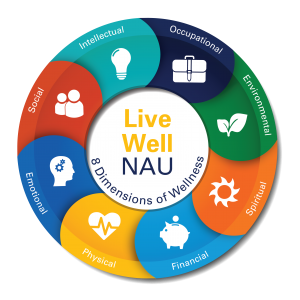
WELLNESS is a process - a developing awareness that there is no end point, but that health and happiness are possible in each moment, here and now - Travis, J.W. & Ryan, R. S., The Wellness Workbook (1988); an active process of becoming aware of and making choices toward a more successful existence. -National Wellness Institute; a holistic concept: it is looking at the whole person, not just their blood pressure, body fat, exercise behavior or what a person had for lunch. It involves physical, social, emotional, occupational, spiritual, and intellectual dimensions.

"If one imagines each aspect as a spoke on a wheel, Wellness helps a person extend
the physical, social, occupational, and intellectual aspects out as far as they can be
developed and practiced. Therefore, a wellness mindset seeks to grow in each
dimension, not just one, so that the wheel rolls smoothly."
- National Wellness Conference

PHYSICAL WELLNESS: a perception and expectation of physical health.

SPIRITUAL WELLNESS: a positive perception of meaning and purpose in life.

PSYCHOLOGICAL WELLNESS: a general expectation that one will experience positive outcomes to the events and circumstances of life.

SOCIAL WELLNESS: a perception of having support available from family, friends, or co-workers in times of need and a perception of being a valued support provider.

EMOTIONAL WELLNESS: possession of a secure self-identity and a positive sense of self-regard; also the ability to cope with and/or improve unpleasant mood states.

INTELLECTUAL WELLNESS: the perception of being internally energized by an optimal amount of intellectually stimulating activity.

Assumptions and Guiding Principles of the Wellness Model TOP

  1. The well-being of every individual within an organization influences the well-being of the organization (and vice versa).

  2. Within an organization, individual and organizational well-being is maintained and advanced through a combination of individual self-regulation and cooperation between individuals

  3. Individuals and organizations tend to seek balance between: (a) maintaining the current level of functioning and (b) pursuing further development.

  4. The safer and more supported an individual feels within an organization, the more likely she will develop higher levels of wellness.

  5. Healthy patterns develop in increments, rather than all at once.

  6. Health risk reduction and prevention or alleviation of illness are not identical to wellness enhancement. Optimal health is achieved by accomplishing both.

EAW Wellness Programs TOP

The EAW office provides three interdependent levels of wellness programming: 1) providing information, 2) facilitating personal change, and 3) facilitating organizational change.
  1. Information: designed to support healthier lifestyle choices (e.g. books, brochures, DVD's, etc.).

  2. Personal Change: Workshops, seminars, classes, individual counseling, biofeedback, and other activities.

  3. Organizational Support: Assistance in establishing more supportive worksites (via consultation and involvement in related projects).

Stages of Change Readiness

The EAW wellness program recognizes that each individual is not equally motivated to seek personal changes in his/her level of health and well being. The following change readiness model (developed by Prochaska & DiClimente, 1986) is used in tailoring wellness programs according to varying levels of motivation:

PRECONTEMPLATION - no intention to make changes in a given area

CONTEMPLATION - intention to make changes in a given area within the next 6 months

PREPARATION - intention to make changes in a given area within the next month

ACTION - changes in a given area have been started (but not completed) within the last 6 months

MAINTENANCE - desired changes have been maintained for more than 6 months

RELAPSE - there exists a perception of a loss of control over making desired changes (may occur in any stage)

Contact Us

Employee Assistance and Wellness

824 S. San Francisco St.
Building #25
Flagstaff, AZ 86001

Mailing:
PO Box 5642
Flagstaff, Arizona 86011

Phone: 928-523-1552
Fax: 928-523-8092

Ask-EAW@nau.edu

Please do not use e-mail for emergency situations – call the EAW office at 523-1552.


Mission

  • NAU HOME
  • ASK US
  • FAQ
 

© 2006 Arizona Board of Regents, Northern Arizona University
South San Francisco Street, Flagstaff, Arizona 86011